Legend of the Demon Cat (2017): A Spellbinding Blend of History and Supernatural Thriller
Legend of the Demon Cat (2017) is a visually stunning supernatural mystery that unravels a centuries-old tale of love, betrayal, and vengeance, led by a vengeful spirit in the form of a demonic cat haunting the Tang Dynasty.
Legend of the Demon Cat
Original title: Yāo Māo Zhuàn
Director: Kaige Chen
Country: China, Japan, Hong Kong

Directed by the renowned Kaige Chen, the 2017 film Legend of the Demon Cat—a Chinese/Japanese/Hong Kong collaboration in the Xianxia genre (a type of Chinese fantasy)—is far too complex to unravel in just 129 minutes, let alone a few paragraphs. To fully comprehend the historical nuances of this multi-layered tale, we need to delve into ancient chronicles.
Legend of the Demon Cat draws inspiration from selected parts of the four-volume novel series Feast with a Demon in the Country of Shamon Kukai Tang aka Shamon kūkai tō no kuni nite oni to utage su by Mineo Yoneyama, also known as Baku Yumemakura. Yoneyama, born in 1951, is a celebrated Japanese fantasy and sci-fi author whose nearly 300 literary creations have sold over 20 million copies in Japan. His stories have been adapted into various formats such as manga, comics, feature films, and TV series, giving him a unique role in bridging the cultural gap between Japan and China.
A Japanese perspective on the Tang Dynasty
In many ways, Legend of the Demon Cat presents a Japanese perspective on an imagined Tang Dynasty of ancient China at the peak of its economic, cultural, and political power (roughly between 618 and 907).
Although delving into Asian politics is not the focus here, it is essential to highlight that director and co-writer Chen is widely regarded as one of the pioneers of the Fifth Generation Cinema. This movement flourished after Zedong Mao died in 1976 and the end of the Cultural Revolution (1966-1976). Alongside notable Chinese director Yimou Zhang, Chen rejected the socialist-realist works of earlier filmmakers from the Chinese Communist Era. In this new cinematic landscape, the 1982 graduates began creating films that reflect on Chinese history, enriched with spectacular visual imagery, realism, and social and cultural criticism. Chen also made cinematic history as the first Chinese director to win the prestigious Palme d’Or award at the 1993 Cannes Film Festival with his delicately politically charged Farewell My Concubine aka Ba wang bie ji.

Historical inspirations for the characters
Let us peel this cultural onion step by step. The protagonists—Kûkai, Letian Bai, and Guifei Yang—are based on historical figures. While they remain practically unknown in the Western hemisphere, the achievements of these religious and artistic innovators are highly acclaimed in the Eastern world.
For instance, in its later evolution, the esoteric teachings of Shingon Buddhism blossomed in Japan under the patronage of monk Kûkai (774-835 AD). Meanwhile, Letian Bai, also known as Juyi Bai (772-846 AD), became one of the most prolific poets of the Tang Dynasty and arguably one of the greatest poets in ancient China. Throughout his life, Bai wrote nearly 3,000 poems. His magnum opus, “Song of Everlasting Sorrow” (Chang Hen Ge) from 809 AD, is considered a literary masterpiece and is still taught in Chinese schools today. Although Bai wrote “Song of Everlasting Sorrow” seven centuries before William Shakespeare’s world-famous plays, some critics compare his poem to Romeo & Juliet, which premiered in 1597. Like Shakespeare, Bai was a poetic troubadour who sang of tragic love. His poem tells the story of Emperor Xuanzong of Tang (685-762) and his beloved concubine Yuhuan Yang, later known as Guifei Yang (719-756), focusing on the emperor’s unbearable guilt and grief after her death.
The poem and the demon cat
In Legend of the Demon Cat, a key element in investigating the mysterious death of the Seventh Emperor of Tang involves a poem recited by a vision of the possessed Chunqin, who walks gracefully like a cat over the rooftop in broad daylight. Using Avant-Holmesian deduction techniques, Monk Kûkai discovers that the recited poem was composed at the wedding banquet of the mythical Yang.
Surprisingly, many people in the Western world are unfamiliar with concubine Yang. However, her unorthodox story is central to the adaptation, making it imperative to acquaint oneself with her legend. Orphaned young, Yang was raised by her uncle, Xuanjiao Yang. At 17, she married Li Mao, the Prince of Shou and the son of Emperor Xuanzong and Consort Wu. After Wu’s death, Emperor Xuanzong fell madly in love with Yang’s breathtaking beauty, artistic talents, and exquisite dancing.
To avoid criticism for taking his son’s wife, the Emperor arranged for Yang to become a Taoist nun before making her his Imperial Consort. She received the title Guifei, which translates to “Precious Concubine,” the highest possible rank in the Tang Dynasty’s harem hierarchy. Although not officially titled Empress, Yang was regarded as such.

The legend surrounding Yang is rich with intrigue. Emperor Xuanzong composed a famous piece of music for her, which was lost and remains highly sought after. Celebrated as one of the Four Beauties of ancient China, Yang became an iconic symbol of beauty and sensuality, making her one of the most famous women in Chinese history.
Alas, rebel forces besieged the capital, Chang’an, and shattered this dream. The Emperor and his concubine attempted to flee to another town, but his troops ambushed them. The soldiers blamed the woman for the country’s recent misfortunes and, according to historical records, forced the Emperor to strangle his beloved concubine. Heartbroken, the Emperor returned to the capital to restore his power. This unorthodox story of Emperor Xuanzong and his concubine haunted the Tang Dynasty for centuries and provides a richer understanding of the historical background of Legend of the Demon Cat. This context is essential because Chen intertwines a paranormal fable with contemporary parallels, blending it with ancient China’s deeply rooted historical tragedy.
Investigation
In essence the film tells the story of an investigation that gradually leads toward a dark secret that, once revealed, can rewrite history. Additionally, the narrative revolves around the influence of a talking demonic cat that places Chunqin, another Consort in the Tang Dynasty court, and later her husband, a general, under its spell, bringing decay to Chang’an.
Meanwhile, at the Imperial Palace, Emperor Xuanzong suffers from a life-threatening delirium and does not sleep for seven consecutive nights. As rumors of haunting spirits spread, the desperation of the court’s medical staff led them to summon a Japanese monk in hopes of curing the Seventh Emperor of the Tang Dynasty. However, the monk, Kûkai, arrives just in time to witness the Emperor’s death. Strangely, Kûkai hears the whining of a concealed cat during the Emperor’s final moments. Recognizing his exceptional skills as an exorcist, the Imperial court commissions Kûkai to solve the mystery with the assistance of the Emperor’s artistic scribe, Bai Letian.
Initially, Bai is skeptical of Kûkai. However, during a feast organized by the husband of the possessed Chunqin, the mysterious killing of fellow officers and court members—who all seem connected to Yang’s death—changes his mind. The presence of a mysterious black cat leads Kûkai to conclude that the Imperial court is cursed.

Little by little, Kûkai realizes that the mysterious black cat is the source of all the mayhem. Despite his knowledge of bakeneko, supernatural cats in Japanese folklore, he struggles understand the interconnections between the various elements.
His breakthrough comes when he sees Chunqin’s face at Yang’s abandoned residence. She reveals that she was once Yang’s beloved cat and had been buried alive with her mistress. This revelation clarifies that the cat’s actions might be part of Yang’s plan for revenge and justice.
Kûkai and Bai physically navigate every corner of the capital to unravel this mystery. These two characters serve as the connection between the present and the past. They are the tools needed to bridge the two eras, and their investigations lead them to uncover the truth about what happened to Yang and the supernatural story of her vengeful black cat.
Kaige Chen’s vision
The film delves into existential themes like love, life, death, obsession, truth, and illusion, all contributing to Kûkai’s search for a profound secret. Philosophical reflections are never far away.
Chen—known for his acclaimed films such as The Emperor and the Assassin aka Jing Ke ci Qin Wang (1998), Killing Me Softly (2002), and the Tang dynasty fantasy The Promise aka Wu ji (2005)—shared in an interview that his motivation for making this film stems from his deep passion for exploring human life. He acknowledges that while this perspective might be challenging for those outside China, he believes these themes resonate universally across all cultures.
The illusion of a perfect couple begins to dissolve in the novel and its film adaptation, revealing the underlying truth. Chen understands that there will always be a tendency to blame a beautiful woman for chaos. Still, he firmly believes that women should not be the automatic scapegoats in any society. He also admires the Tang Dynasty culture, which he views as remarkably open and inclusive, similar to ancient Greek society around 3,000 years ago. During the seventh century of the Tang Dynasty, about 30,000 foreigners lived in the capital. As long as they could speak Chinese and pass the exams, being a foreigner did not hinder their chance of becoming a government official—a level of inclusivity that remains rare today. Chen honors this spirit of open-mindedness by working with diverse film crews and casting actors from various countries. Japanese actor Shōta Sometani portrays the shaman monk Kûkai, while Chinese actor Xuan Huang plays Bai. Taiwanese actress Sadrinne Pina takes on the role of the beautiful Lady Yang, and Chinese actress Yuqi Zhang, also known as Kitty Zhang, embodies Chunqin with intense passion.
Conclusion
With a $200 million budget and a massive cast, Legend of the Demon Cat smashed all records and stands as the most expensive Chinese film ever made. While screenwriter Wang Hui-Ling, known for Crouching Tiger, Hidden Dragon aka Wo hu cang long (2000), likely commanded a significant fee, but the majority of the enormous budget went into reconstructing the city of Chang’an. After filming, this elaborate set transformed into a tourist attraction. Despite this, Chen felt it still resembled a typical studio set, so he had over 20,000 trees planted to enhance its authenticity over time. Given that traditional Chinese aesthetics are perspective-free and eschew 3D effects, Chen used computer-generated imagery sparingly, reserving it mainly for creating the Demon Cat. The production took over six months, not to mention the more than five years needed for the trees to mature. Then again, not many Chinese films garner 13 awards and 23 nominations. In every sense of the word, epic!
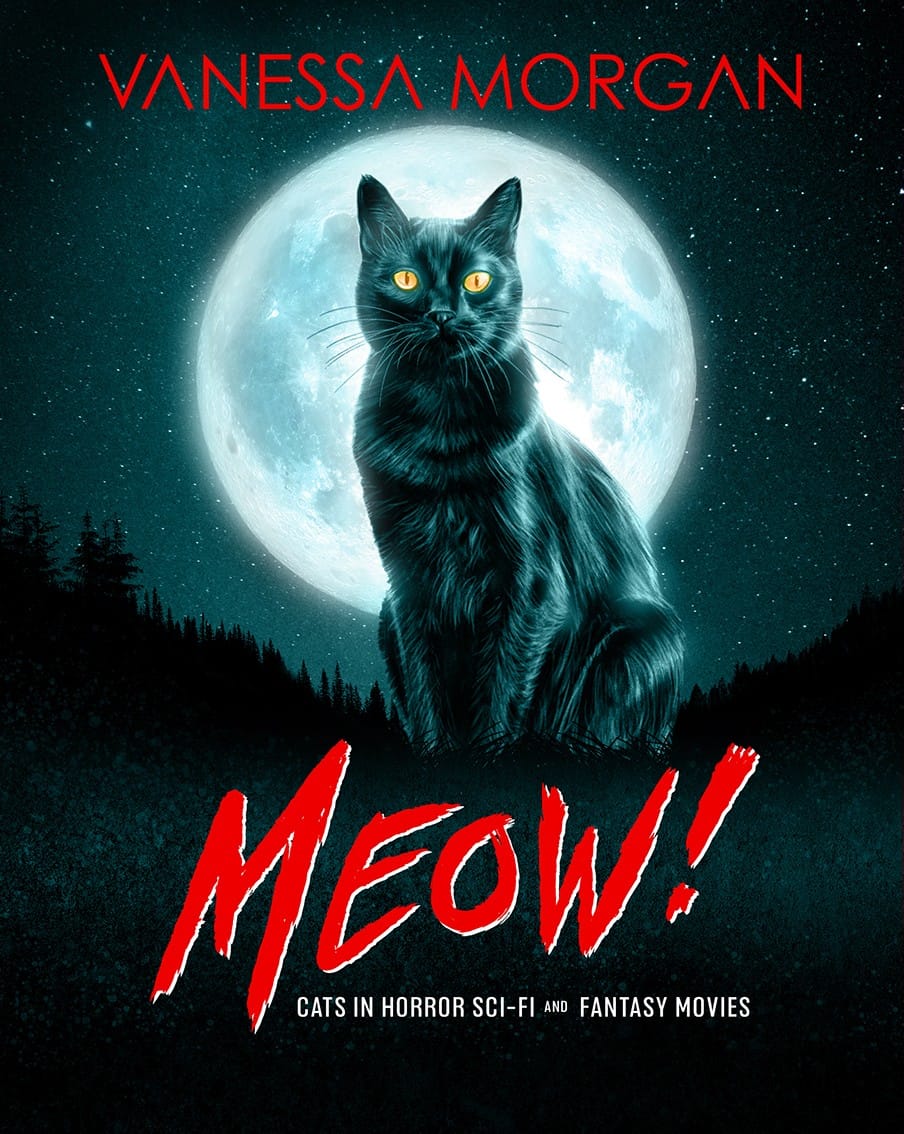
Read more about Legend of the Demon Cat and many other cat-centric genre movies in Meow! Cats in Horror, Sci-Fi, and Fantasy Movies.
About the author
SVEN DAEMS explores unorthodox art forms, compiles playlists for one of Europe’s oldest active jazz clubs (Hnita-Hoeve), and spins obscure DJ sets. When he is not learning to pronounce hexakosioihexekontahexaphobia, he is probably reading about art, music, film, bizarre food, alternative politics, philosophy, witchcraft, Philippine lore, and Japanese mythology. For over a decade, he ran his websites—Svn’s Corner and Svn’s Corky Corner—and recently launched a new digital platform, Svn’s Unsane Vortex. As a guest writer, Sven wrote articles about music, film, and art for different blogs, newspapers, and magazines. He also contributed essays to the books When Animals Attack: The 70 Best Horror Movies with Killer Animals, Strange Blood: 71 Essays on Offbeat and Underrated Vampire Movies, and Evil Seeds: The Ultimate Movie Guide to Villainous Children.
Check out these other reviews by Sven Daems: