The Black Cat (1941): Murder, Inheritance, and Feline Symbolism
In the cozy mystery The Black Cat (1941), a wealthy matriarch’s heirs are killed one by one. A black cat is key to uncovering the killer.
The Black Cat
Director: Albert S. Rogell
Country: USA

Black Cats in Greek Mythology and Christian Traditions
In Western horror cinema’s great saga of cats, one type of feline stands out: the black cat.
The fear of these purring monsters has deep roots, stretching back to Greek mythology.
Hecate was often depicted with black cats by her side, and in some versions of myth, she could transform into a black cat herself.
In one well-known myth, Hera, the wife of Zeus, turns her servant Galinthias into a black cat as punishment for tricking her.
Afterward, Galinthias was adopted by Hecate to serve as her companion, further cementing the association between black cats and the supernatural.
This connection to a powerful and mysterious goddess contributed to the enduring fear and suspicion surrounding cats in later folklore.
In the early Middle Ages, when Christian traditions began blending with older pagan festivals, black cats became associated with Halloween and Samhain, the Celtic festival marking the end of the harvest season.
As Christianity spread, the church sought to replace pagan festivals with Christian observances, and Samhain eventually evolved into what is now Halloween.
During this time, folklore about witches and spirits grew, and black cats, believed to be witches’ familiars or witches in disguise, became a central part of the supernatural imagery of Halloween.
This association solidified in the 16th and 17th centuries, during the height of witch hunts and trials in Europe and colonial America.
Black cats were often killed alongside women accused of witchcraft because it was commonly believed that witches could transform into black cats to carry out their nefarious deeds under the cover of darkness.
This superstition lingered through the Renaissance and well into the modern era.

Edgar Allan Poe’s Psychological Symbolism in The Black Cat
Edgar Allan Poe tapped into these symbolic associations when he penned his famous short story “The Black Cat” in 1843.
However, rather than casting the cat as a demonic figure, Poe used it to embody justice and symbolize the protagonist’s guilty conscience.
Poe masterfully uses the cat, Pluto, as a psychological symbol, reflecting the protagonist’s inescapable consequences of his actions.
The second black cat, which appears after Pluto’s death, serves as a living embodiment of retribution, leading to the protagonist’s downfall.
This use of the cat as an instrument of moral justice contrasts with traditional depictions of black cats as purely evil, adding complexity to the story’s themes.
Poe’s “The Black Cat” inspired numerous cinematic adaptations, starting with a segment in the 1919 German anthology film Eerie Tales.
Although many of these adaptations strayed from the original story, they retained one key element: the black cat as a symbol of justice and guilt.
Edgar G. Ulmer’s 1934 The Black Cat
Edgar G. Ulmer’s The Black Cat (1934) is a prime example of a film that has nothing in common with Poe’s work beyond the core themes.
Even the black cat itself is barely noticeable.
Ulmer’s version is better known for its unique blend of Gothic horror, futuristic design, and psychological tension.
However, the film’s title capitalized on the growing popularity of Poe’s stories in the early 20th century.
Despite these differences, this version became a classic, sparking renewed interest in Poe’s works.
Previously, the author’s popularity had already risen due to his works entering the public domain, allowing filmmakers to freely adapt and reimagine the author’s tales, leading to a surge of adaptations in the 1930s and beyond.
The success of Ulmer’s The Black Cat boosted Poe’s visibility in the film industry and solidified the black cat as a recurring figure in horror cinema, both as a literal and symbolic presence.
The Black Cat (1941) – Old Dark House Mystery
Contrary to how distributors promoted it, the 1941 murder mystery The Black Cat also significantly deviates from Poe’s original story.
The script fits the mold of Paramount Pictures’ hit film The Cat and the Canary (1939).
The plot and tone are more akin to the “Old Dark House” stories and the works of Agatha Christie, with Poe’s title and themes serving only as loose inspiration.
Unlike the other adaptations, however, this film has more than a few cats gracing the screen.
The Black Cat Story
The plot revolves around Henrietta Winslow (Cecilia Loftus), a wealthy and eccentric matriarch who adores her dozens of cats (except black ones) and keeps them roaming freely in her mansion.
Her family, eager to claim their share of her fortune, gathers at her estate, hoping for her imminent death.
The potential heirs include her niece, Myrna Hartley (Gladys Cooper), her husband, Montague (Basil Rathbone), and her stepson, Richard (Alan Ladd).
Also in line to inherit are Henrietta’s grandson, Stanley Borden (John Eldredge), her gardener, Edwardo Vidos (Bela Lugosi), and her granddaughter, Elaine Winslow (Anne Gwynne), who is notably the most selfish family member.
Additionally, two men interested in purchasing the estate are also part of the story: the family’s lawyer, Gilmore Smith (Broderick Crawford), and Mr. Penny (Hugh Herbert), an unwieldy antique dealer and friend of Hubert.
However, Henrietta’s will contains a peculiar clause: no one will inherit anything until her loyal servant Abigail (Gale Sondergaard, who appeared in The Cat and the Canary and would later star in another cat-themed horror, 1973’s The Cat Creature) and the cats are gone.
Abigail will be allowed to stay in the mansion if she manages the estate for the benefit of the cats, and any harm to the animals will disqualify the heirs from receiving the inheritance.

The intrigue begins when someone attempts to kill Henrietta with poisoned milk, but Gilmore intervenes, and the poison ends up killing a cat instead.
That evening, Henrietta is found dead, apparently having fallen onto a knitting needle.
Only Gilmore suspects foul play.
The discovery of a black cat near Henrietta’s body, seemingly the sole witness to the crime, deepens the mystery.
As the night progresses, the heirs are murdered one by one, starting with Abigail.
The mysterious black cat witnesses each of these crimes.
Secret passages in the mansion add to the confusion, causing suspicion and paranoia to run high among the remaining family members.
Amid the chaos, Gilmore tries to solve the murders and uncover the true culprit behind the killings.

In a nod to Poe’s classic tale, the black cat plays a crucial role in exposing the murderer.
The climax reveals Myrna’s attempt to dispose of both Elaine’s body and the black cat.
Gilbert hears the animal’s plaintive wails emanating from the incinerator, and this leads him to the discovery of the bodies.
The estate is eventually sold, bringing the dark drama to a close.
The final shot features the black cat sitting on the chair leading to the secret passageway.
This time, it is accompanied by a litter of newborn kittens, signifying the end of the cycle of death that has plagued the Winslow estate.
The presence of the kittens suggests a new beginning and a return to normalcy after the chaos and murder.
Legacy
The 1941 version is less well-remembered and revered than its 1934 predecessor.
Although it boasts a strong cast, the film’s shift toward comedy missed the mark with audiences expecting a more traditional horror experience.
As a result, it is often considered more of a curiosity than a landmark in horror cinema.
Nonetheless, it is a pleasant film, especially if you are a cat lover.
Watch The Black Cat 1941
You can currently rent or buy The Black Cat (1941) from Amazon Prime Video.
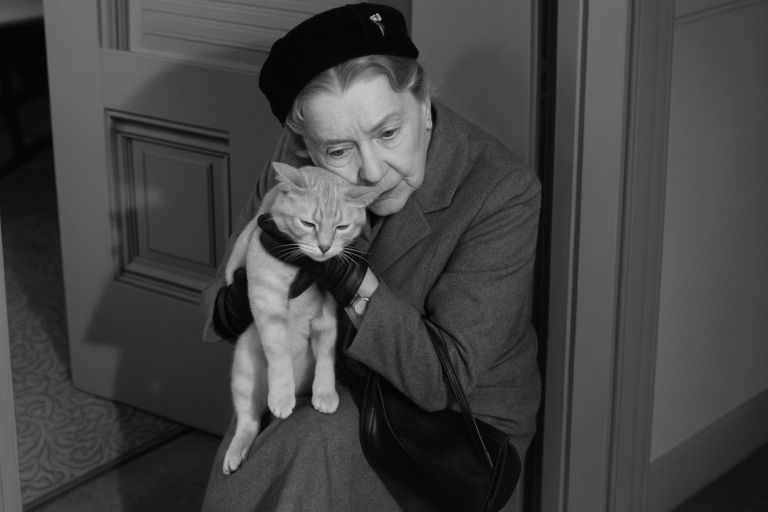
Watch next: Alfred Hitchcock Presents: Miss Paisley’s Cat
Pin The Black Cat Movie Poster!

Explore More Movies Featuring Black Cats
Looking for more horror movies about black cats? Start with these entries below:
- Kuroneko (1968)
- The Black Cat (1981)
- The Tomb of Ligeia (1964)
- Legend of the Demon Cat (2017)
- The Case of the Black Cat (1936)
About the author
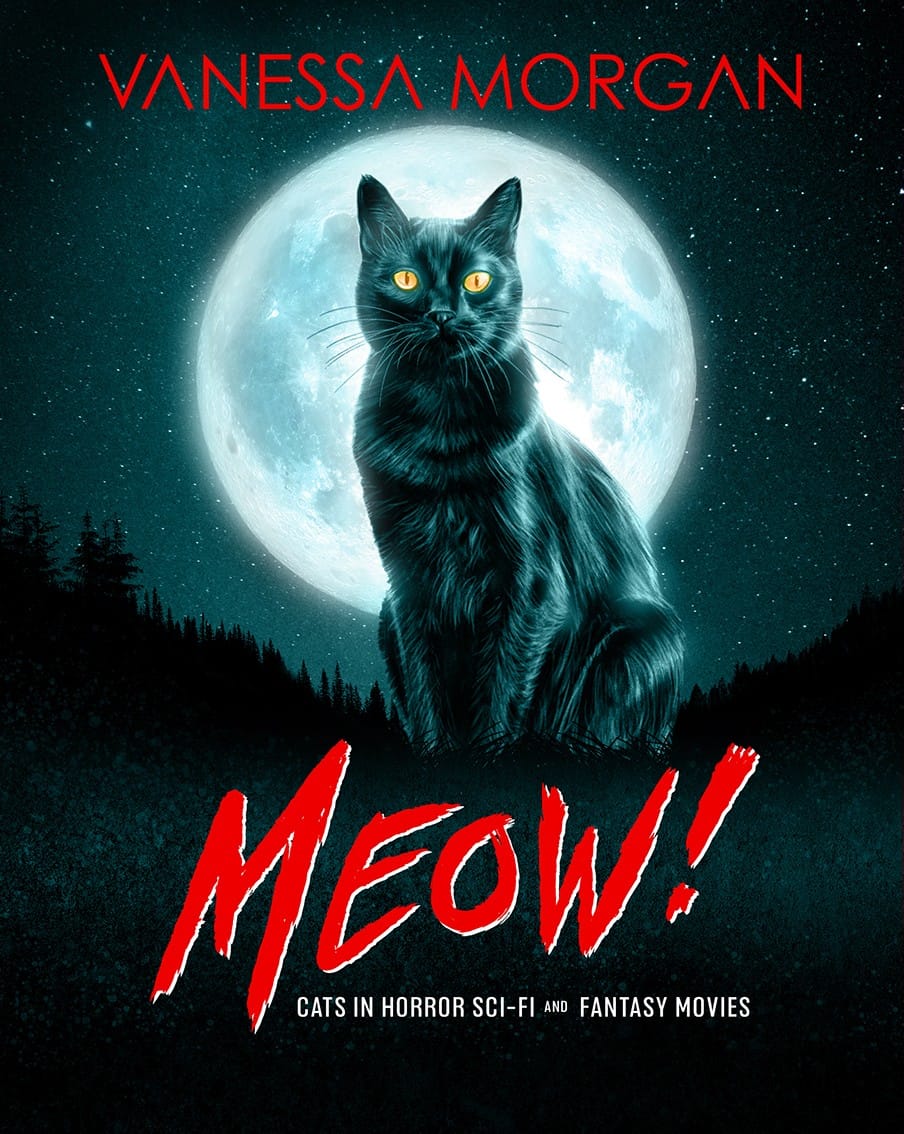
Vanessa Morgan is the editor of When Animals Attack: The 70 Best Horror Movies with Killer Animals, Strange Blood: 71 Essays on Offbeat and Underrated Vampires Movies, Evil Seeds: The Ultimate Movie Guide to Villainous Children, and Meow! Cats in Horror, Sci-Fi, and Fantasy Movies. She also published one cat book (Avalon) and four supernatural thrillers (Drowned Sorrow, The Strangers Outside, A Good Man, and Clowders). Three of her stories became movies. She introduces movie screenings at several European cinemas and film festivals and is also a programmer for the Offscreen Film Festival in Brussels. When she is not writing, you will probably find her eating out or taking photos of felines for her website, Traveling Cats.
Discover more movies with cats in my book Meow! Cats in Horror, Sci-Fi, and Fantasy Movies.